What is a DAS System? A Practical Guide for Oklahoma Businesses
If your building has dead zones, dropped calls, or unreliable cellular service, you are not alone.
Many businesses assume this is just part of being indoors or part of having a large facility. But the reality is, poor signal is not something you have to accept.
It is something you can fix.
That is where Distributed Antenna Systems, or DAS, come in.
For organizations across Oklahoma, DAS is becoming a critical part of modern infrastructure, especially in environments where communication, connectivity, and reliability cannot fail.
What is a DAS System?
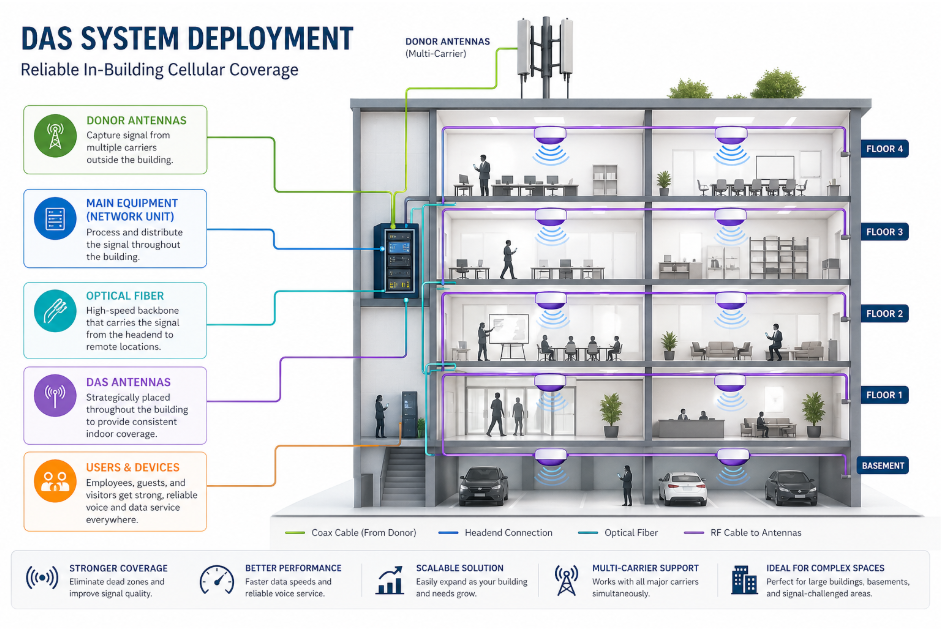
A Distributed Antenna System is a network of antennas placed throughout a building or campus to improve cellular signal coverage.
Instead of relying on a single outdoor tower to penetrate walls, floors, and structural barriers, DAS distributes the signal inside the building where it is actually needed.
This creates consistent coverage across:
-
Offices and corporate buildings
-
Hospitals and healthcare facilities
-
Schools and universities
-
Warehouses and industrial environments
-
Large commercial or public spaces
Rather than dealing with weak or inconsistent signals, users experience stable, high-quality connectivity throughout the entire space.
Why Traditional Signal Coverage Falls Short
Most buildings were never designed with wireless performance in mind.
Materials like concrete, steel, and energy-efficient glass can significantly block or weaken cellular signals. As buildings become more advanced, the problem often gets worse, not better.
Add in more devices, higher data demands, and increased reliance on mobile connectivity, and the limitations become obvious.
This is why many businesses experience:
-
Dropped calls in key areas
-
Slow or inconsistent data speeds
-
Poor connectivity in lower levels or interior spaces
-
Frustration from employees, customers, and guests
At a certain point, adding more carriers or upgrading plans does not solve the issue. The problem is not the provider. It is the environment.
How DAS Solves the Problem
ADAS system brings the signal inside and distributes it intelligently.
Instead of forcing devices to reach a distant tower, DAS ensures that antennas are placed strategically throughout the building. This allows signal strength to remain consistent regardless of location.
The result is:
-
Reliable voice and data performance
-
Improved user experience across all devices
-
Better support for high-density environments
-
Stronger connectivity for critical operations
For organizations that rely on real-time communication, this is not just a convenience. It is essential.
Where DAS Fits into Your Network Infrastructure
DAS is not a standalone solution. It works as part of a larger connectivity strategy.
For example, businesses already investing in wireless networks or network security solutions often discover that cellular performance becomes the next bottleneck.
That is where DAS integrates with:
-
Wireless Networks to support internal connectivity
-
Wired Networks to ensure stable back-end infrastructure
-
Structured Cabling to support proper system deployment
-
Network Security to protect connected devices and data
When designed correctly, DAS becomes an extension of your overall network, not just an add-on.
Key Components of a DAS System
While the exact setup varies, most DAS systems include:
Signal Source
This connects to a carrier network or signal provider.
Head-End Equipment
This manages and distributes the signal throughout the system.
Distributed Antennas
Placed throughout the building to deliver consistent coverage.
Cabling Infrastructure
Supports communication between all components, making structured cabling a critical part of performance.
Each piece plays a role in ensuring the system operates efficiently and reliably.
Benefits of DAS for Oklahoma Organizations
For businesses and institutions across Oklahoma, DAS offers more than just better signal.
It delivers operational advantages.
Consistent Coverage
Eliminates dead zones across large or complex facilities.
Improved Productivity
Employees stay connected without interruptions.
Better Customer Experience
Guests, clients, and visitors expect reliable connectivity.
Support for Critical Systems
Especially important in healthcare, education, and public sector environments.
Scalability
DAS systems can grow with your building and technology needs.
Why Professional Design and Deployment Matters
DAS is not a plug-and-play solution.
It requires careful planning, engineering, and integration with your existing systems.
This is where professional services become essential.
From site surveys and signal analysis to installation and ongoing support, a properly designed DAS system ensures long-term performance.
Without this level of planning, businesses often end up with inconsistent results or systems that fail to meet expectations.
The Future of Connectivity is Distributed
As buildings become smarter and more connected, the demand for reliable indoor coverage will continue to grow.
More devices. More data. More dependence on mobile connectivity.
DAS is not just a solution for today’s problems. It is an investment in future-ready infrastructure.
For Oklahoma businesses, this means staying ahead of connectivity challenges instead of reacting to them.
Final Thoughts
If your building struggles with poor cellular coverage, it is not something you have to work around.
It is something you can solve with the right approach.
A well-designed Distributed Antenna System improves coverage, enhances performance, and supports the way modern organizations operate.
And when combined with the right network infrastructure and professional support, it becomes a long-term advantage, not just a short-term fix.
FAQs
What is a DAS system used for?
A DAS system is used to improve cellular signal coverage inside buildings where traditional signals are weak or inconsistent.
Who needs a DAS system?
Organizations with large buildings, dense construction materials, or high connectivity demands benefit the most, including schools, hospitals, and commercial facilities.
How is DAS different from WiFi?
WiFi provides internet access through local networks, while DAS improves cellular signal from mobile carriers.
Is DAS expensive to install?
Costs vary depending on building size and complexity, but the long-term benefits in performance and reliability often outweigh the investment.
Can DAS support multiple carriers?
Yes, modern DAS systems can be configured to support multiple carriers, depending on system design.
How do I know if my building needs DAS?
If you experience dropped calls, poor signal, or inconsistent connectivity indoors, a DAS assessment can determine if it is the right solution.